Tuesday, 15 September 2015

Invasion of the Traditional British Pint Snatchers


The latest on beer in The Guardianhttp://www.theguardian.com/lifeandstyle/2015/sep/11/brewsters-women-brewers-men-inside-micropub-world-dancing-man
All the new cliches (see http://robocono.blogspot.com/2015/06/shocking-news.htmlare there: 1. Beards - 100% hit rate for all men interviewed (both of them), 2. Citrus, 3. Pale Ale: “...the beer itself... “citrusy pale ale”, 4. Passion: the head brewer “always had a passion for pubs” and 5. Fruit Beer: ...“beer that hinted at mango and papaya”.

But there is one shocking new revelation: the head microbrewer claims English hops are “dull and a bit boring”, and we are told authoritatively that “The best hops are from New Zealand, Australia and the US, with the UK catching up mainly with blends grown to mimic the more tropical foundations”.

Passing over the question of WTF the journalist imagines a “tropical foundation” might be, the implications of this confidently stated 'fact' are staggering: although we invented the Pale Ale which is the new default setting for beer, our native hops are now considered inferior and are being crossed with other strains to make them more like foreign ones (presuming that's what “blends grown to mimic” means).

So, not only are the forces of classic late model capitalism at work to stop you getting the pint you like - by which I mean the illusion of choice concealing the operation of oligarchy, in that more and more breweries are taken over by larger ones, and their beer replaced by that of the large one while still being marketed under the old name (Thwaites, Jennings and Tetley by Marston's, too many to list by Greene King) - and more foreign hops are being used here, but 
British hops are being genetically modified to produce beer that tastes like lemon juice or tropical fruit juice


No wonder traditional Bitter is getting harder to find and the sale of Mild is under threat, it  sounds like it will soon be impossible to brew traditional British beer any more.

(For those of you who were expecting more fashion victim revelations, normal service will resume shortly...)

Before
After


Thursday, 10 September 2015

More Fashion Victims

Further to my observation about people wearing their hats over their ears, in http://robocono.blogspot.com/2014/06/mens-hats-in-tv-period-dramas.html: I noticed someone wearing their baseball hat over their ears the other day, and he happened to take it off while I was doing so.

His ears were deformed! Nipped in against the skull at the top and then flaring out until a normal attitude was achieved. Since then I've noticed a significant minority of young men with ears deformed in this way.
(Not the man I noticed, by the way)
I had previously speculated that perhaps this fashion was about more than ignorance or taking gang bangers as style icons (ignorance at one remove), and that it may have something to do with the wearer being concerned about having stickie-out ears, and attempting to nip a wingnut tendency in the bud, as it were. But if that is the case, the job only gets half done, leaving them with this absurd hybrid effect.

Friday, 4 September 2015

State sponsored kitsch offensive

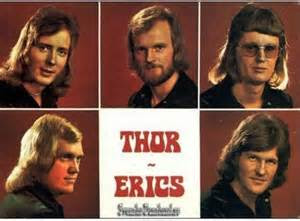
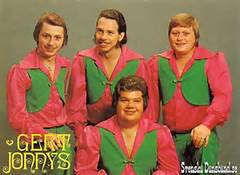
Thanks to my friend https://www.facebook.com/richard.tellstrom, I now know the reason why the stage outfits of Swedish dansbands in the 1970s are streets ahead of the competition in Ireland and Norway when it comes to making us laugh today.

Expenses for stage outfits were tax-deductible, but only if the clothing claimed for was solely for professional use and of such an appearance that it precluded use as everyday wear.   

But it's more than just the clothes - what makes these pictures so horribly compelling is the combination of extremes, the visual oxymoron of absurdly flamboyant costumes being worn by people with yokel-like goofy faces from a village fete gurning competition.

And the names.


He's got the Schytts


Tuesday, 1 September 2015

Swedo-Hibernian Parallels


It's a little-known fact that Sweden and Ireland enjoyed (if that's the right word) until quite recently, remarkably similar versions of an aspect of popular culture seminally (and that probably is the right word) involved with rural courtship rituals and, ultimately, the diversification of the national gene pool in recent modern history.

Dansbands and Showbands. These parallel phenomenons both involved the travelling of large distances by rural populations, particularly young adults of romantic and/or sexual proclivity, to attend entertainments provided by groups of musical artistes inexplicably similar in styles of dress, combination of instruments and conventions of rhythm, tempo, characteristic genre and vocal rendition (the inspirations being 60s light entertainment dancebands and Country & Western).


The venue for these events was the church or village hall, or more typically in the remote areas where the ritual had most significance, a more rudimentary structure of unique application:
in Sweden the dansbana, an outdoor wooden dancefloor and stage with a shed-like bar and snack kiosk,
in Ireland the dance hall, an adapted barn or rudimentary and hastily-constructed breeze-block and board shed, or sometimes a marquee. 

The Swedish incarnation has the edge in the stage costume department, the Irish in closeness of vocal and musical authenticity to the American sources of origin.
Dublin, Cork, Waterford, Wexford and Limerick are, of course, Viking cities, but we don't see any mobile musical genre cum rural marriage bureau phenomenon of the type of the Dans- or Showband in the former territories of the Danelaw east of the river Lea in London. 

(But, while there is no indigenous culture of peripatetic transatlantic musical schlock  and awe, this might go some way to explaining the unusual enthusiasm for Line Dancing in Essex.


Wednesday, 19 August 2015

Equatorial Migration

Posts here about changing fashions in beer and the young people who follow them get by far the biggest viewer numbers.
In the interests of market research and narrowing down exactly what the attraction is, here's 
some observations about changing fashions/young people without  the beer.
Aptly titled Swedish loons

I've always been a fan of the high waist in trouserwear, from Oxford Bags to Bowie Bags (as advertised along with split knee loons, often in the same ad,  in music papers, and worn by their eponym during his Hunky Dory period), and, although not as personal wear, A-line Bags with a 3-button waistband and 3 inch turn ups, usually worn with a 3 star sweater showing some lower chest, all the way to the logical apotheosis of the full-blown Patrick Moore look.


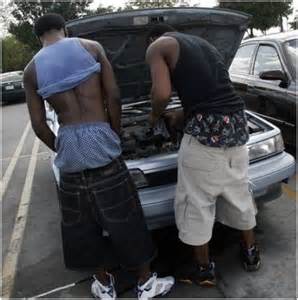
I've regarded with grave misgivings the apparently ineluctable tide of the ever-lower waistline, at times allied with the ever-lower crotch, in that case revealing more and more of the wearer's choice of brand in underpant (fashion industry singular). 
That particular style seems to be on the wane, although at its height we saw young men voluntarily rendered unidexterous when upright by the need to keep a grip on their pants to stop them falling around their ankles.


The aftermath of that trend is still with us, and has combined with the Norman Wisdom/Pee Wee Herman-style size-too-small fashion in menswear (see: http://robocono.blogspot.no/2014/09/defibrillated-frankensteins-monsters-of.html) to produce an obligatory builder's arse effect in any level of deviation in posture from the fully upright, and displacing the back pockets to the top of the thigh so that the wearer ends up sitting on anything in the pockets.

The effect is of altering the anatomical proportions to give the appearance of having an extremely long body with severely  truncated legs. 
This effect is further enhanced by the wearing of shoulder bags with an absurdly long carrying strap, placing the bag at mid-thigh level;  as wilfully awkward and counter-intuitive as the similarly generationally-divisive practice of swinging the arms from side to side across the front of the body when walking (see: http://robocono.blogspot.no/2014/10/the-light-is-seen.html)

Simon Cowell and Jeremy Clarkson have done their best to stem the tide of the ever-falling waistband by personal example, but I'm pleased to announce a more credible champion of opposition to this craze to simulate a cartoon character body/lower limb ratio. 


I have seen the future, and its name is Leon Bridges.

“At the beginning, people didn’t understand it,” he says of his style, “especially in Fort Worth, Texas. They see a young black man wearing high-waist pants, up to his nipples, and shirt tucked in, and they’re just [his voice ascends to an astonished falsetto] ‘WHA’???????’ But eventually they started to respect it.” - Interview by Michael Hann in The Guardian

Wednesday, 12 August 2015

Results of Scientific Study Confirm Blogger's Suppositions

Further to my Shocking News posts of 1st and 9th of June:
Bearded, flat hatted and dreadlocked 'hipsters' outnumber traditional CAMRA members by a ratio* of 7 to 15 in this rigorous randomised study** of UK beer drinkers conducted by a major public institution***   recently: http://www.theguardian.com/uk-news/gallery/2015/aug/12/great-british-beer-festival-camra-in-pictures

And another thing: why does everyone under the age of 30 say "Can I get..." in a bar, shop or restaurant when they want something, which in an equitable world would be greeted with the response "No you can't, because you don't work here. I have to get it for you."?

* An unconventional ratio involving the use of actual numbers
** of people appearing in close-up in the photographs shown in this on-line article in
*** The Guardian